Why Europeans Are Leaving Their Dream Cities (and How to Pay Less Rent)
Short answer: Europe's most loved cities became too expensive for the people who live in them. Since 2010, EU house prices have risen about 58% and rents about 28%, and in some cities rent now eats almost a full local salary. The good news: you don't always have to leave the country to fix it. Often you only have to move one train line out.
Picture it. You finally made it to the city you dreamed about: the cafés, the old trams, the river at sunset. Then the first rent bill arrives. In Lisbon that is not a figure of speech. An analysis reported by The Portugal News in May 2026 found the average one-bedroom in the city centre costs about €1,331 a month, while the average net salary is about €1,343. That leaves roughly twelve euros for everything else.

The number behind everything
According to Eurostat, the EU's statistics office, house prices across the European Union rose by almost 58% between 2010 and early 2025, and rents by about 28%. In Portugal prices more than doubled (+130%); in Hungary they rose about 260%. Wages did not keep up. So people started doing something that would have sounded absurd twenty years ago: leaving the cities they fought so hard to live in.
Eleven cities, one story
In London, about 420,000 people moved out to other parts of the UK in the year to June 2025, while only about 289,000 moved in, a net loss of roughly 132,000 (ONS). Paris lost nearly 6% of its population in eleven years, according to France's statistics office. In Barcelona, tens of thousands marched against rents in November 2024, and the city promised to phase out its roughly 10,000 licensed tourist flats by 2028.
The pattern repeats elsewhere. In Milan, students pitched tents outside the Politecnico in May 2023 to protest rents. Venice's historic centre fell from about 175,000 residents in 1951 to fewer than 49,000. In Stockholm, people who got a flat through the city's housing queue in 2023 had waited nine years on average. In Berlin, average rents in 2025 were 69% higher than ten years earlier, according to German federal government figures.

The Icarus paradox
Put the cities side by side and the same story keeps coming back. A city becomes so successful, so loved and so desirable that it starts pushing out the very people who made it special: the baker, the musician, the young family, the nurse on the night shift. They don't leave because they stopped loving the city. They leave because the city stopped having room for them. That's the idea behind our new video series on the Icarus Paradox channel.
How to pay less without leaving
Here's the part most articles skip. In almost every big European city, rent drops by a quarter to a half once you cross the city line, while a train or metro still gets you to the centre in 15 to 40 minutes. The trick is to compare rent plus the monthly transport pass, not rent alone.
| City | Cheaper option | Rent difference | Getting in |
|---|---|---|---|
| Paris (€33.3/m²) | Montreuil (€24.5/m²) | −26% | Metro 9, ~15 min to République |
| Barcelona (€20.1/m²) | Sabadell (€13.0/m²) | −35% | Rodalies R4, ~35–40 min |
| Madrid (€23.4/m²) | Getafe (€15.1/m²) | −35% | Cercanías C-4, ~15–20 min |
| Milan (€22.3/m²) | Sesto San Giovanni (€15.3/m²) | −32% | Metro M1, ~20 min |
| Munich (€22.9/m²) | Augsburg (€14.5/m²) | −37% | Regional train, ~40–45 min |
Advertised or average rents per m² per month, autumn 2026 (MeilleursAgents, Idealista, Immobiliare.it, immoportal). Always check current listings.
Some regions make this even easier with flat-rate passes. Île-de-France's Navigo costs €90.80 a month whether you live in central Paris or the suburbs, and Germany's Deutschlandticket (€63) covers local and regional trains nationwide. Living in Montreuil instead of Paris, a 40 m² flat can save around €350 a month at the same transport cost.
It's not always worth it. In London, rail season tickets from commuter towns can eat most of the saving, so an outer borough inside the Travelcard zones is often the smarter move. And for artists leaving Berlin, Leipzig is about a third cheaper, but it works as a move rather than a daily commute, since the Deutschlandticket doesn't cover ICE trains.

Turn the saving into freedom
A lower rent changes your life only if the difference goes somewhere. The classic guideline is an emergency fund of three to six months of essential expenses, kept somewhere safe and instantly available, like an instant-access savings account (EU deposits are protected up to €100,000 per person per bank). Saving €350 a month on rent builds a €4,500 fund in about thirteen months, without cutting anything else. This is general information, not financial advice.
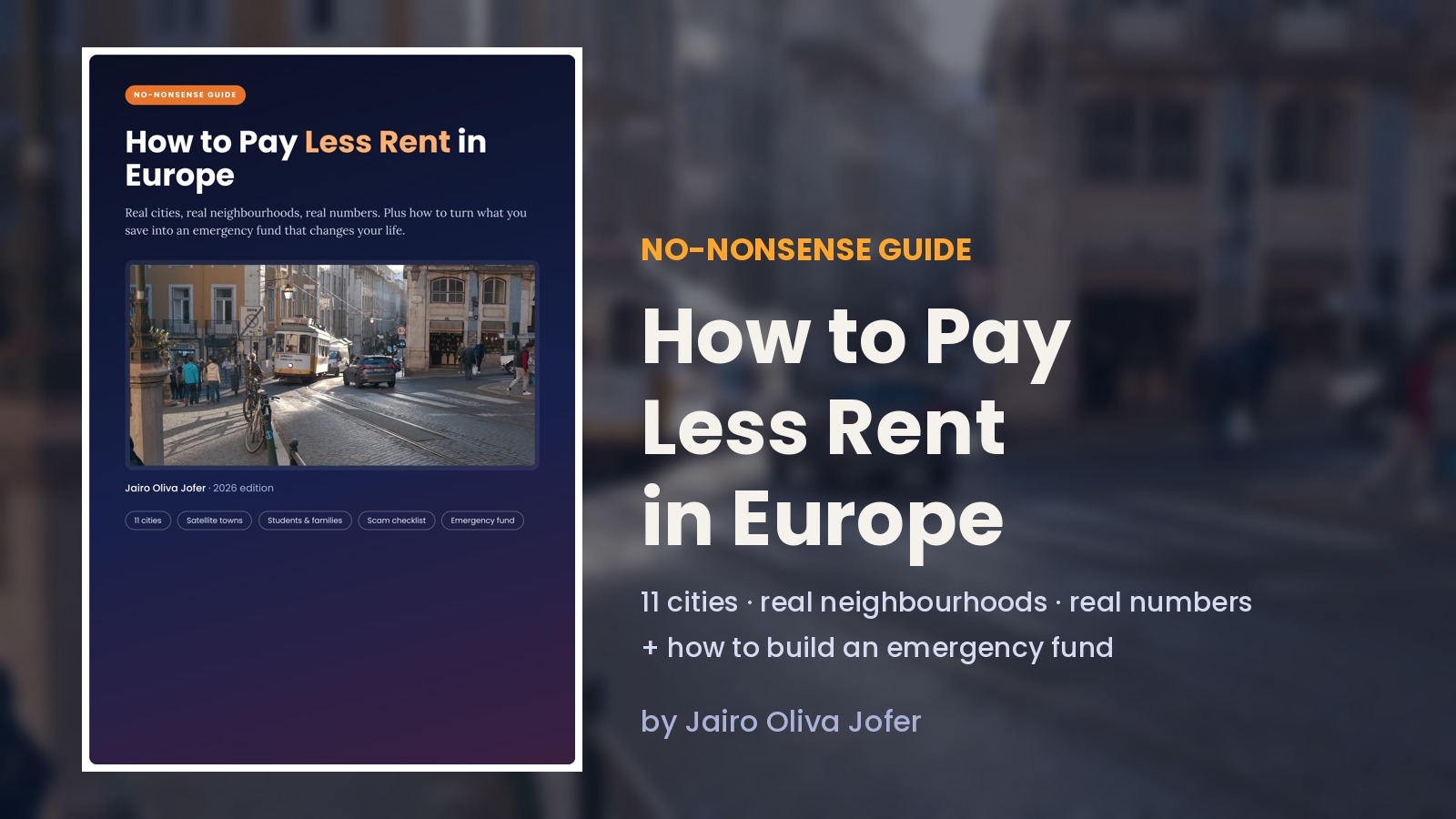
How to Pay Less Rent in Europe
My 19-page guide: 11 cities with real neighbourhoods and numbers, tools for students and families, a scam checklist, and how to build an emergency fund with what you save.
Get the guide for $5 →FAQ
Why are people leaving big European cities?
Mostly housing costs. Since 2010, EU house prices rose about 58% and rents about 28% (Eurostat, early 2025), far faster than wages in many places. In Lisbon, the average one-bedroom rent in the centre is close to the average net salary.
Which European city has the worst rent-to-salary ratio?
Lisbon is one of the most extreme: an analysis reported by The Portugal News in May 2026 put the average centre one-bedroom at about €1,331 a month against an average net salary of about €1,343.
How can I pay less rent and still live near a big city?
Look at satellite towns and districts on a good train or metro line, and compare rent plus the monthly pass. In Paris, Montreuil averages about €24.5/m² against €33.3/m² in Paris, and the Navigo pass costs the same €90.80 everywhere.
Where are people moving instead?
Most stay in their own country, moving to cheaper towns. A smaller group of remote workers and retirees look further, toward cheaper EU and Balkan countries. Part 2 of our video series covers five of them.
Sources
- Eurostat, house price and rent indices (Q1 2025)
- The Portugal News / Tradingpedia, Lisbon rent vs salary (May 2026)
- ONS via LBC, London internal migration (year to June 2025)
- INSEE, Paris population; Euronews, Barcelona protest (Nov 2024)
- ANSA, Milan student tent protests (May 2023); Bostadsförmedlingen i Stockholm (2023)
- German federal government figures via The Berliner (Apr 2026)
- MeilleursAgents, Idealista, Immobiliare.it, immoportal.com rent data (Sept–Oct 2026); Île-de-France Mobilités; Deutschlandticket 2026
- EU Directive 2014/49/EU (deposit guarantee)
Is this happening in your city? Tell us in the video comments what a one-bedroom costs where you live.
Subscribe to Icarus Paradox →Keep reading



More from our channels
Jairo Oliva Jofer
Digital nomad. Brazilian living in Serbia, formerly in Berlin. Jairo writes honest, no-fluff guides on money and income, and tells rise and fall stories on the Icarus Paradox channel. See all guides →