Rent vs Buy in 2026: How Many Years Until Buying Beats Renting?
Update, October 23, 2026: Freddie Mac's October 22 reading put the 30-year fixed rate at 7.32% (a year earlier: 6.19%). In this model the base case stays at year 11, with principal and interest of about $2,581 a month. The numbers in this article use the October 15 reading, 7.40%.
Short answer: it depends on three numbers, not on the mortgage payment. With October 2026 inputs (a $417,500 home, 10% down, a 7.40% rate) and a comparable home that rents for $2,500 a month, buying overtakes renting after about 11 years if prices rise 1.3% a year. Across the scenarios below, the break-even runs from year 3 to year 24, and the typical seller in the latest Realtors' survey had owned for 11 years.
This is general education, not financial advice. It uses a made-up couple, Iris and Dev, and my own arithmetic on published figures. Break-even years show how the question works; they are not a forecast.
The quick version, in three steps
1. Count only the money that is gone: for an owner, interest, property tax, insurance, upkeep, closing and selling costs, minus the price gain; for a renter, the rent. Principal is not gone, because it comes back as equity. 2. Run it under slow, flat and faster price growth. 3. Compare the crossing year with the number of years you honestly expect to stay.
What the mortgage calculator shows
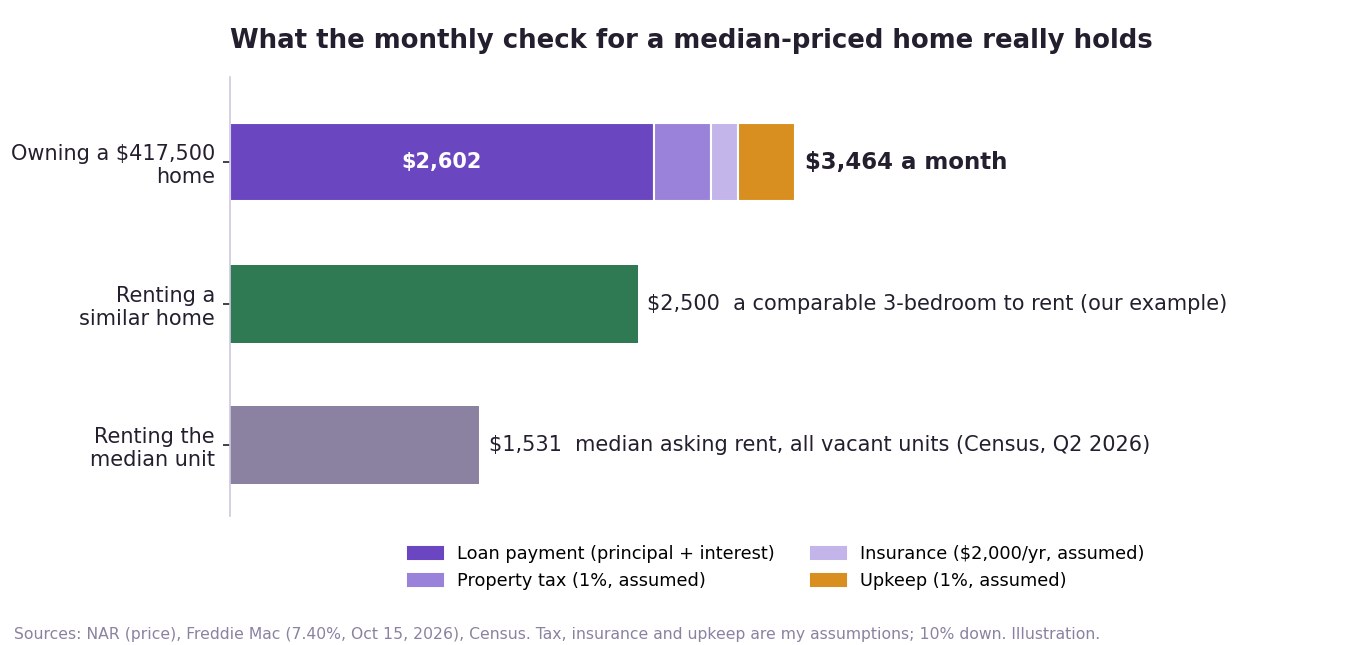
The National Association of Realtors reported a median existing-home price of $417,500 for September 2026, up 1.3% from a year earlier (summarized by Mortgage News Daily; NAR's own release was published October 13). Its 2025 buyer survey found a typical first-time down payment of 10%, or $41,750 here, leaving a loan of about $375,750. Freddie Mac's weekly survey put the 30-year fixed rate at 7.40% on October 15, against 6.27% a year earlier. Principal and interest come to about $2,602 a month. At last year's rate it would have been about $2,318, so the same house costs roughly $283 more every month.
What the calculator leaves out
The CFPB reported median closing costs and fees of nearly $6,000 in 2022, so treat that as a floor. Property taxes vary widely by county (New Jersey has the highest effective rate, per the Tax Foundation). The NAIC reported in August that homeowners premiums rose in every region since 2018 even after inflation, by 18% to 43%. I use placeholders: 1% of value for property tax, $2,000 a year for insurance and 1% a year for upkeep. Yours will differ.
Where the first dollars go
In month one, about $2,317 of the payment is interest and about $284 is principal. Over the first year that is roughly $27,700 of interest and $3,500 of principal. After five years of on-time payments, about $135,500 has gone to interest, about $20,600 to principal, and about $355,000 is still owed. Principal is real equity, but early on most of the check is a cost.
The renter's side
The Census Bureau's latest quarterly survey puts the median asking rent for vacant rental units at $1,531 (second quarter of 2026), and its five-year survey puts median gross rent at $1,413, about $100 more than five years earlier. BLS reported shelter prices up 3.2% over the 12 months to September. Harvard's Joint Center for Housing Studies said nearly half of renter households were cost burdened in 2024. The median rental is not the same home as the median house, so the fair comparison is what a similar home rents for near you.
The break-even year
I count the owner's money that is gone, subtract the price gain, and compare it with rent that rises 3% a year. I leave out what the down payment could have earned elsewhere, which would push every number below later. Year one is expensive for the owner, about $64,000 against $30,000 of rent, mostly interest, upkeep and the cost of getting in and out. By year five the gap is about $35,000, and by year eleven the lines meet in the base case.
| Rent $2,000 | Rent $2,500 | Rent $3,000 | |
| Prices flat | year 24 | year 16 | year 9 |
| Prices +1.3% a year | year 19 | year 11 | year 6 |
| Prices +3% a year | year 11 | year 5 | year 3 |
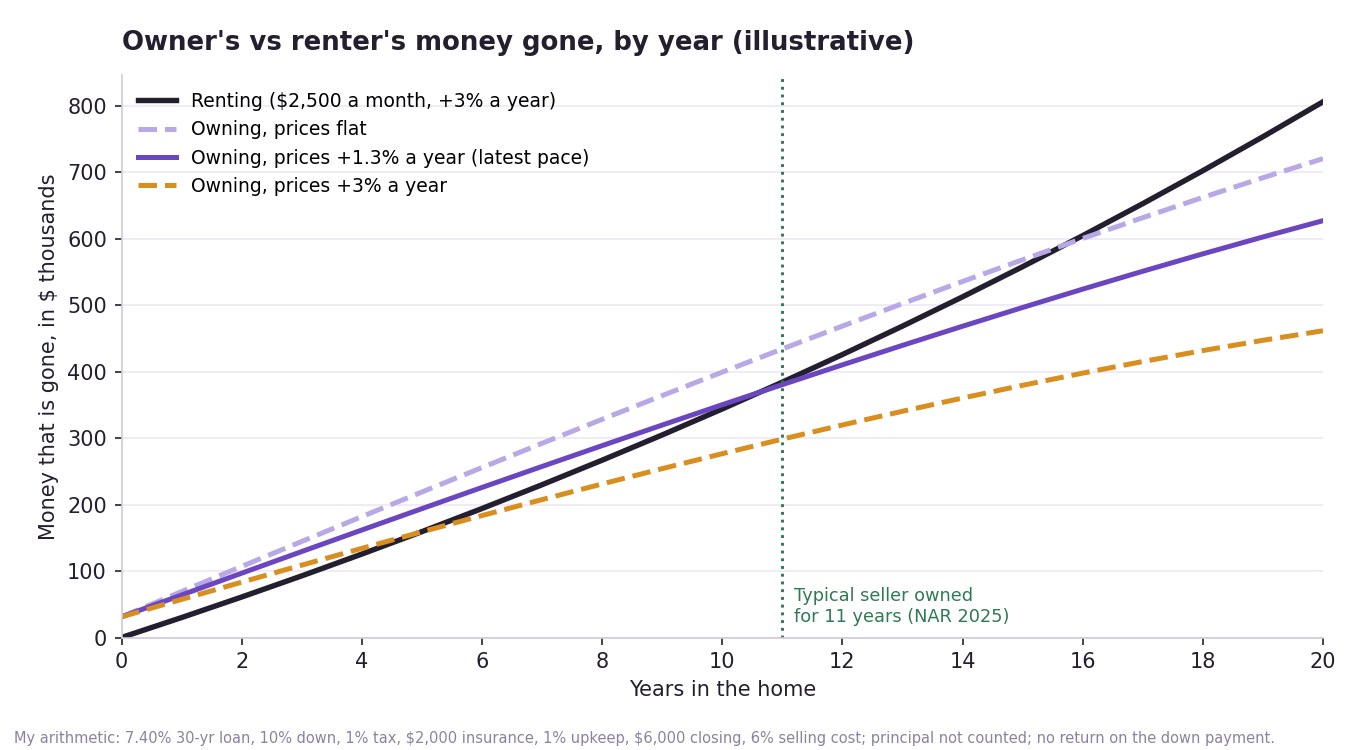
The rate matters too: rerun the base case at last year's 6.27% and break-even comes in year seven instead of year eleven. And the model cannot hold your life: a job in another city or a market dip when you need to sell. Here, selling costs 6% whether you leave in year three or year thirty.
Your own check in 20 minutes
Ask a lender for a written loan estimate. Look up the property tax for the actual address and get an insurance quote. Pick an upkeep placeholder and call it one. Find three real rents for comparable homes and use the middle one. Then write down how many years you honestly expect to stay, and see whether the lines cross before or after that year. If the numbers are close, what a spreadsheet cannot price, such as stability or the freedom to leave on 30 days' notice, is part of the answer.
Looking at the income side? Start with the free three-day test
Our free three-day side hustle test checks an idea before you build anything, and this fee breakdown shows where a $7 digital sale really goes. For the full step-by-step method, with prompts and a seven-day plan, there is a paid guide. It does not promise any income.
See the guide (PDF) →FAQ
How many years do you have to stay in a house for buying to beat renting?
It depends on price growth, on what a comparable home rents for, and on the mortgage rate. In this illustration (a $417,500 home, 7.40% rate, 10% down, $2,500 rent for a comparable home, prices up 1.3% a year) break-even is about year 11. Across the scenarios tested it runs from year 3 to year 24.
Is renting really throwing money away?
Rent builds no equity, but an owner also has money that does not come back: in this example about $27,700 of interest in year one, plus property tax, insurance, upkeep and the costs of buying and selling. The useful comparison is the money that is gone on each side, year by year.
What is the monthly payment on a median-priced home in October 2026?
For a $417,500 home with 10% down at Freddie Mac's 7.40% average on October 15, principal and interest come to about $2,602. With assumed property tax, insurance and upkeep of about $862 a month, the total check is about $3,464. These are my calculations, and your numbers will differ.
How much are closing costs?
The CFPB reported that the median borrower paid nearly $6,000 in closing costs and fees in 2022. Costs vary by lender, loan and location, so use the written loan estimate for your actual figure.
Does the break-even include what my down payment could earn elsewhere?
No. I left it out on purpose to keep the model simple. Including it would make owning look worse and push every break-even year later.
Sources (opened and read): Freddie Mac, Primary Mortgage Market Survey, October 15, 2026. NAR, Existing-Home Sales, September 2026 (released October 13, 2026), and the Mortgage News Daily summary of it (October 16) for the $417,500 median price. NAR, 2025 Profile of Home Buyers and Sellers (November 4, 2025). U.S. Census Bureau, Quarterly Residential Vacancies and Homeownership, Q2 2026 (July 28, 2026), and ACS 2020-2024 housing costs story (January 29, 2026). BLS, Consumer Price Index, September 2026. CFPB, "Junk fees are driving up housing costs" (March 2024). NAIC, homeowners insurance market trends (August 5, 2026). Harvard JCHS, State of the Nation's Housing 2026 (June 2026). Tax Foundation, property taxes by state and county (March 2026). Iris and Dev are made up. Assumptions that are mine: 1% property tax, $2,000 insurance, 1% upkeep, 6% selling cost, rent up 3% a year, $6,000 closing costs, no return on the down payment. All payments and break-even years are my own arithmetic and are illustrative. Educational content only, not financial advice.
Keep reading


More from our channels
Jairo Oliva Jofer
Digital nomad. Brazilian living in Serbia. Jairo writes honest, no-fluff guides and tells rise and fall stories on the Icarus Paradox channel. See all guides →