How to Price a Digital Product: Your Floor, Your Ceiling and a Simple Test
Short answer: price a digital product in three moves. First find your floor, the lowest price that still leaves you something after fees. Then find your ceiling, the price at which buyers start to say "too expensive". Then pick a number between the two and test it. No method guarantees sales, but this one stops you from guessing blindly.
Most people price a PDF, a template or a prompt pack by feel: a number that sounds fair, maybe ending in .99. The trouble is that a digital product costs almost nothing to copy, so a price set by feel is easy to get too low and awkward to fix later. Here is a routine you can finish in a weekend.
Step 1: Find your floor, because fees come first
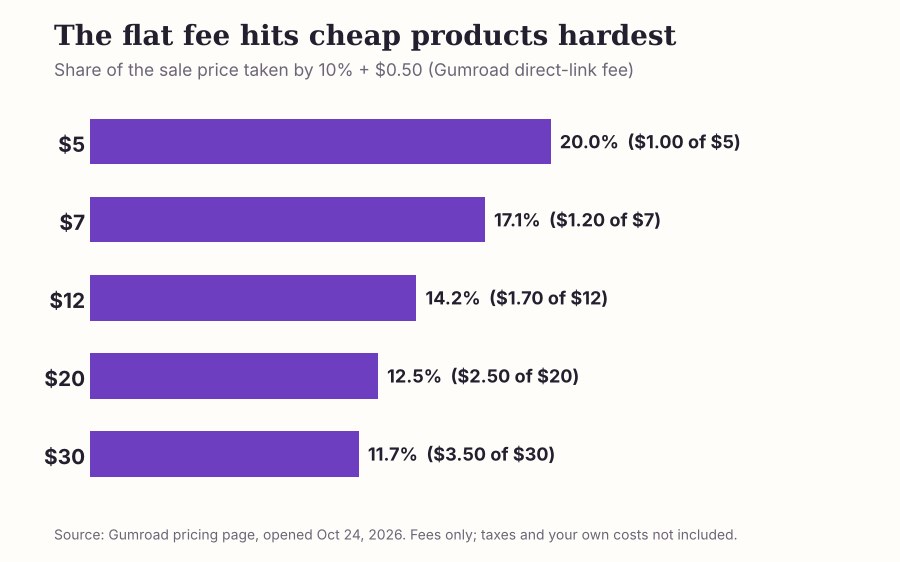
A flat per-sale fee does not shrink when your price does, so cheap products lose a bigger share. Gumroad's pricing page (opened October 24, 2026) lists 10% plus $0.50 per sale through your own link, no monthly fee, and 30% when a new customer finds you through its Discover marketplace. On direct sales that works out like this:
- $5 product: fee $1.00, you keep $4.00 (the fee is 20% of the price).
- $7 product: fee $1.20, you keep $5.80 (17.1%).
- $12 product: fee $1.70, you keep $10.30 (14.2%).
- $30 product: fee $3.50, you keep $26.50 (11.7%).
Etsy works differently. Its fees page (last updated October 5, 2026) lists $0.20 per listing and a 6.5% transaction fee, plus a payment processing fee that varies with the country of your bank account, and an Offsite Ads fee of 15% on orders it attributes to those ads (12% once a shop has $10,000 or more in sales over the prior 365 days). We followed one $7 sale through both platforms in Etsy Fees Explained.
Fees are only part of your floor. Add your own costs, such as software subscriptions, and remember that income earned from sales may be taxable where you live. This article is not tax advice. If a sale leaves you nothing worth the effort, change the price or the product.
Step 2: Find your ceiling with four questions
Market researchers use a method called the Van Westendorp Price Sensitivity Meter. It asks buyers four questions about a product:
- At what price is it so low that you question its quality?
- At what price is it a bargain?
- At what price does it begin to seem expensive?
- At what price is it too expensive?
Qualtrics explains that the point where the "questions its quality" and "too expensive" lines cross is the optimal price point. The same article is clear about the limits: answers are subjective and you need enough respondents to offset outliers, and the result is a starting point to validate in real purchase conditions, not a final price.
With a small audience you will not get a rigorous number, and that is fine. Ten or twenty answers from people who actually have the problem give you a rough range for free. Ask in a poll, in your comments, or in a community where your buyers already talk (follow its rules on self-promotion). Look first at the answers to question four: the number where most people stop is your ceiling.
Step 3: Look at what else is on the shelf
Search the marketplace where you plan to sell and note the price of five products that solve the same problem. Compare what the buyer gets: pages, format, updates, support. Prices are only comparable when the products are. Do not copy the cheapest listing, because it may be priced for volume or by someone with different fees. Use the range as a sanity check against your floor and ceiling.
Step 4: Pick one price and test it
Choose a number between floor and ceiling and do not agonize over $9 versus $10. Thomas and Morwitz proposed in 2005 that people anchor on the leftmost digit, so $1.99 feels closer to $1 than to $2. A Wikipedia overview of psychological pricing notes that the theory is controversial and that results from modern scanner data are mixed. A test with your own audience tells you more than a theory.
- Change one thing at a time: the price, not the title, the cover and the price together.
- Keep each price live long enough to collect a meaningful number of visitors before you judge it.
- Write down visitors, clicks to the buy page and sales for each price.
- With little traffic, a handful of sales cannot prove anything. Treat early numbers as hints.
Four common pricing mistakes
Pricing by hours spent. Buyers pay for the result they expect, not for your hours. Ignoring the flat fee. On a $5 product one fifth of the price is gone before anything else. Changing the price every few days. You never learn what worked. Going so low the product feels disposable. The survey's first question exists because some buyers read a very low price as a warning about quality.
If you are still deciding what to sell, start with the free three-day side hustle test or see how one Reddit complaint became a $7 product in this walkthrough.
Want ready-made prompts for each step?
"7 AI Prompts to Build, Price & Sell Your First Digital Product" is a $7 PDF with one prompt for each real stage: validate, generate, refine, design, price, list and promote. A small first step; it does not guarantee any income.
Get the prompt pack ($7) →FAQ
How do I price a digital product?
Work in three steps: find your floor (the lowest price that still leaves something after platform fees), find your ceiling (the price at which buyers start to say it is too expensive), then pick a price between the two and test it with real visitors. No method guarantees sales.
How much should I charge for my first digital product?
There is no number that fits everyone. Start from your floor after fees and a short survey of people who have the problem. For reference only, the guides on this site are priced between $5 and $12, which is our choice and not a rule.
Is it better to price low or high?
A flat per-sale fee takes a bigger share of a low price: with 10% plus $0.50 it is 20% of a $5 sale and 11.7% of a $30 sale. Very low prices can also make some buyers doubt quality, which is why the Van Westendorp survey asks about it. A higher price needs a clearer promise and proof.
Should I end my prices in .99?
Research is mixed. The left-digit effect proposed by Thomas and Morwitz in 2005 says people anchor on the first digit, but an overview of psychological pricing notes the theory is controversial and that results from modern scanner data are mixed. Test it instead of assuming.
Do platform fees change the price I should set?
Yes. Fees set your floor. On Etsy the published fees include $0.20 per listing and a 6.5% transaction fee, plus a payment processing fee that depends on your bank country. On Gumroad direct sales it is 10% plus $0.50. Check each platform's page before you decide, because fees change.
Sources consulted: Gumroad, pricing page (gumroad.com/pricing), opened October 24, 2026, shows no update date; Etsy, "Fees & Payments Policy" (etsy.com/legal/fees), last updated October 5, 2026; Qualtrics, "Van Westendorp pricing explained" (February 7, 2019), a vendor article promoting its own survey templates; Wikipedia, "Psychological pricing", on Thomas and Morwitz (2005). Fee examples are our own arithmetic from the published rates, before taxes and payment-method differences. Fees change, so check each page before you decide.
Keep reading



More from our channels
Jairo Oliva Jofer
Digital nomad. Brazilian living in Serbia. Jairo writes honest, no-fluff guides and tells rise and fall stories on the Icarus Paradox channel. See all guides →